
Equity bears’ count is rising but is nowhere near past peak levels. With bulls having struggled to capitalize on opportunities, the major equity indices have taken a hit but may continue to come under pressure in the right circumstances for sellers.
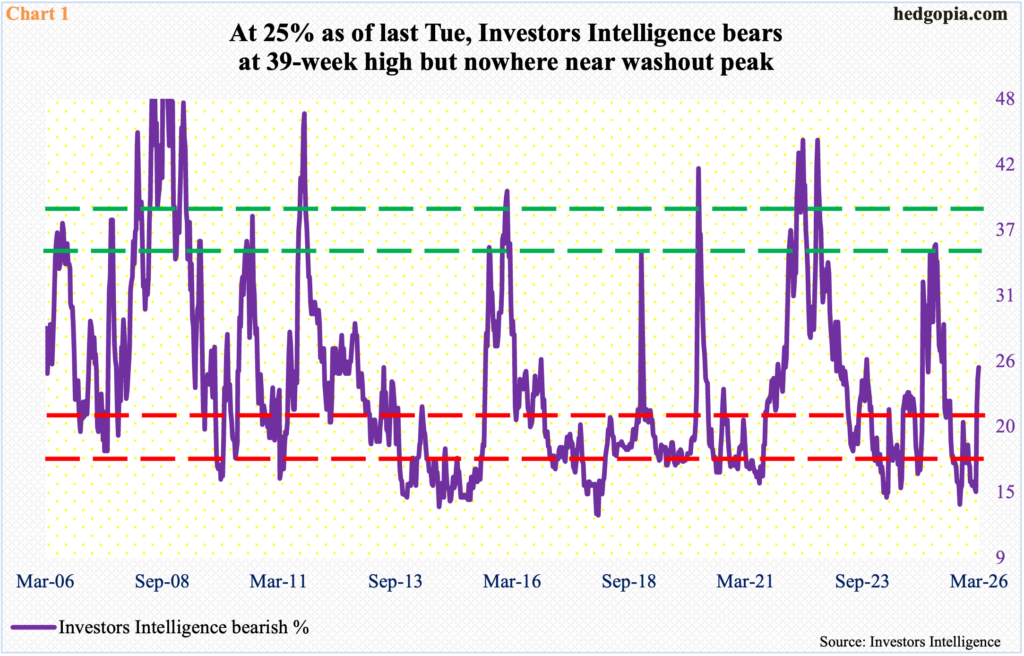
Investors Intelligence bears hit a 39-week high as of Tuesday last week. The bearish percent has gone up each week from 14.6 percent three weeks ago to the latest 25 percent. On the surface, this may look like a steep jump, which it is, but the bears’ count is nowhere near a sustainable peak, which in the past has tended to take place in mid- to high-30s, even 40s (Chart 1).
At 39.3 percent last week, bulls, too, have steadily dropped from a reading of 62.3 percent in early February, but a durable bottom does not occur until their count reaches high-20s to low-30s.
The point in all this is that the bearish percent could go a lot higher before every bear that could have wanted to get out would have done so, suggesting equities’ path of least resistance is down in the right circumstances for shorts. Tomorrow’s Investors Intelligence reading will reveal more on this.
Bears are particularly faring well as bulls are failing to cash in on the chances that have come their way.
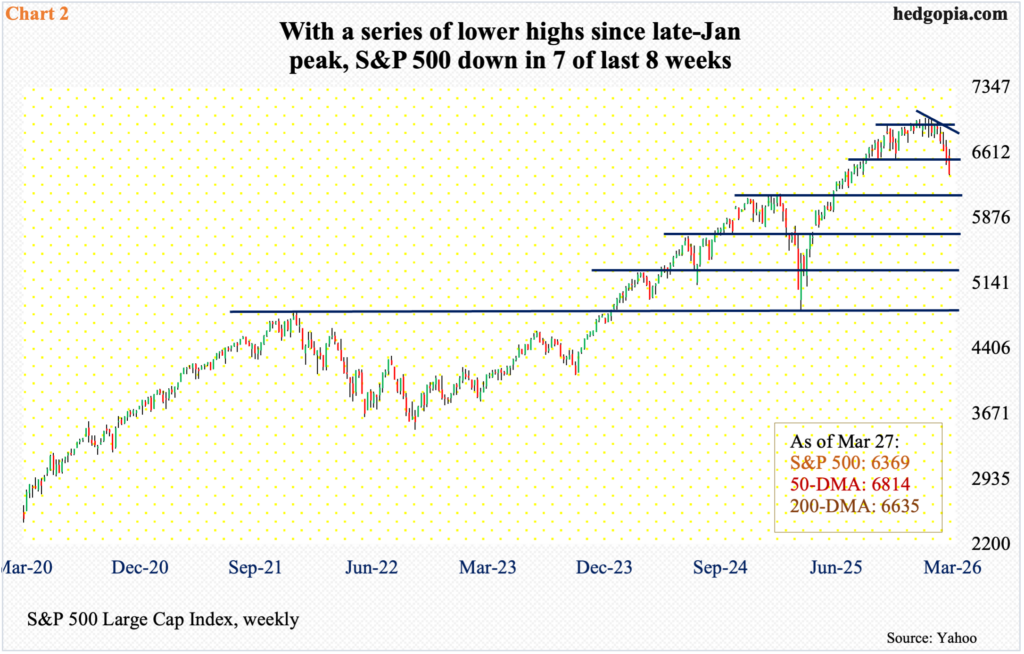
On the S&P 500, bulls have had a few opportunities to mount a sustained relief rally, but bears have more than welcomed this as an opportunity to go short. One such opportunity on the long side arose last Monday when the 200-day was captured intraday but lost by close; this occurred again on Wednesday. By Friday, the index finished 266 points below the average (6635), closing at 6369. In the week before, bulls had an opportunity to reclaim 6770s but were denied as sellers/shorts took control at 6754.
Down 2.1 percent last week, the large cap index has now been down for five weeks in a row. Since it posted a new all-time high 7002 on 28 January, there has only been one up week in eight. Through last Friday’s session low 6356, the index is down 9.2 percent from that high. With negative momentum taking hold, a major bull-bear battle can evolve at 6120s (Chart 2). In the event a relief rally unfolds in the sessions ahead, bears can once again congregate around 6470s, where Friday gap-down will be filled.
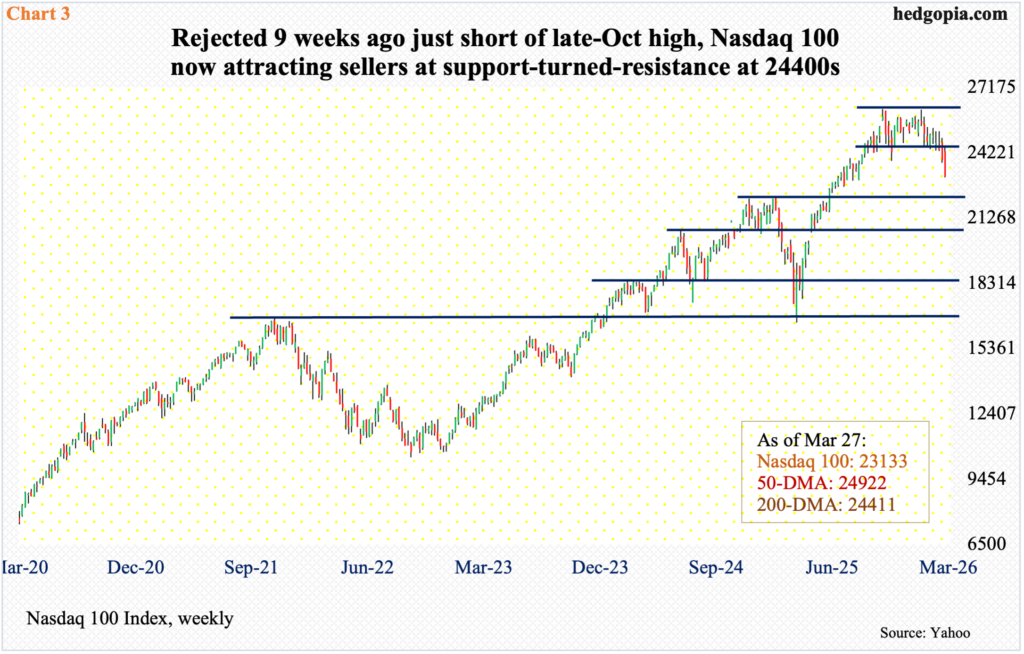
Over on the Nasdaq 100, bulls had an opportunity to reclaim the 200-day (24411) last Monday but only to witness aggressive selling at 24400s. In the latter sessions of February, a similar attempt to win back the 50-day was denied.
Tech bulls have been on the defensive since 28 January when they were just 17 points shy of the all-time high 26182 recorded on 29 October (Chart 3). Including the week in which that double-top rejection took place, the index has been down in eight of nine weeks. Last week, it gave back 3.2 percent to 23133. Through Friday’s session low 23089, the Nasdaq 100 is down 11.8 percent from the peak.
Ahead, there is minor straight-line support at 22900s, followed by make-or-break 22100s.
As things stand, bulls are also struggling in the small-cap arena.
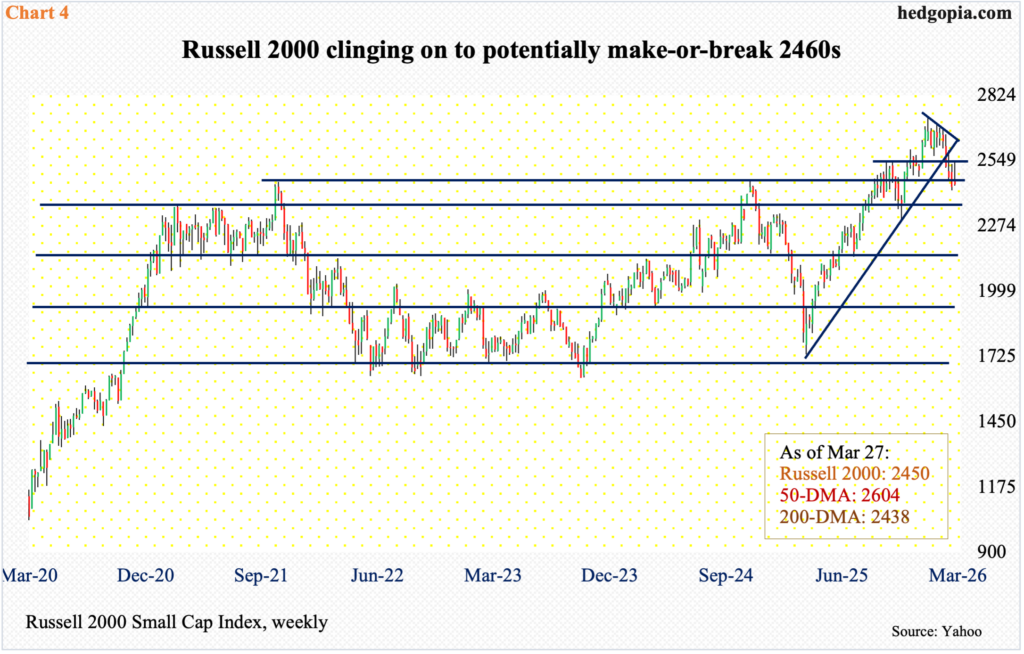
The Russell 2000 was heavily rejected last Wednesday when it tried to reclaim 2540s. Three weeks ago, small-cap bulls failed to defend breakout retest at 2540s; this was then followed by breakout retest at 2460s, which until now has not been decisively breached.
The significance of 2460s goes back to November 2021 when the Russell 2000 rose to 2459 and reversed lower. Three years later, in November 2024, it retreated after ticking 2466. Last September, those highs were surpassed, but not before a stretched bull-bear tug of war followed around those highs (Chart 4).
Last week, the Russell 2000, unlike its large-cap peers, rose, up 0.5 percent to 2450 – just below the crucial 2460s. The index also continues to hover above its 200-day (2438). These are positives. Once again, this should be viewed as a potential opportunity for equity bulls to conjure up a relief rally – duration and magnitude notwithstanding. Failure to do so will make the index vulnerable to a drop toward 2300; the index peaked at 2735 on 22 January, before making a series of lower highs. In this scenario, the Investors Intelligence bearish count will have further moved closer to a potential peak.
Thanks for reading!
