
Going back several weeks, even months, equity bears have had their chances, but to no avail. But they are staying put with their bearish bias. In fact, they are increasingly getting more aggressive. Short interest on both the Nasdaq and NYSE is at a record. This even as the major U.S. indices are beginning to show signs of fatigue.
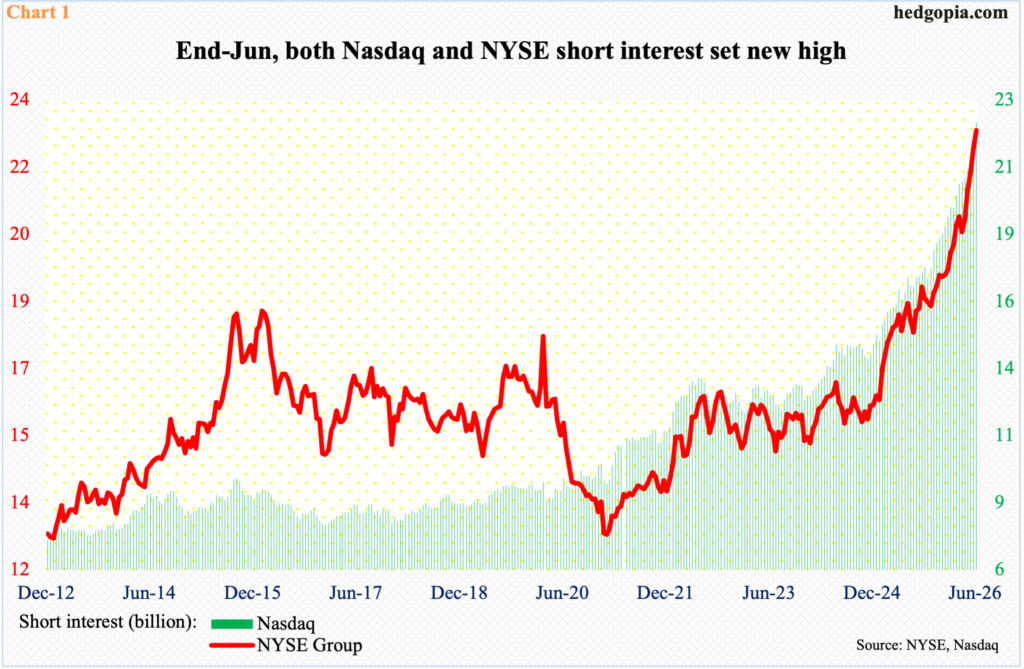
At the end of June, both Nasdaq and NYSE short interest set fresh highs; in the first six months this year, short interest is up 22.2 percent and 19 percent respectively to 22.7 billion and 23 billion (Chart 1).
There has been a nearly parabolic rise in short interest over two and a half months to three months. This is also a period marked by a sideways price action in particularly the tech-heavy index. The Nasdaq Composite surged 31.4 percent from March 30 to June 1 when it peaked at 27190, closing last week at 25520; similarly, the NYSE Composite between March 30 and July 7 was up 12.3 percent to a peak of 24160, closing last week at 23817.
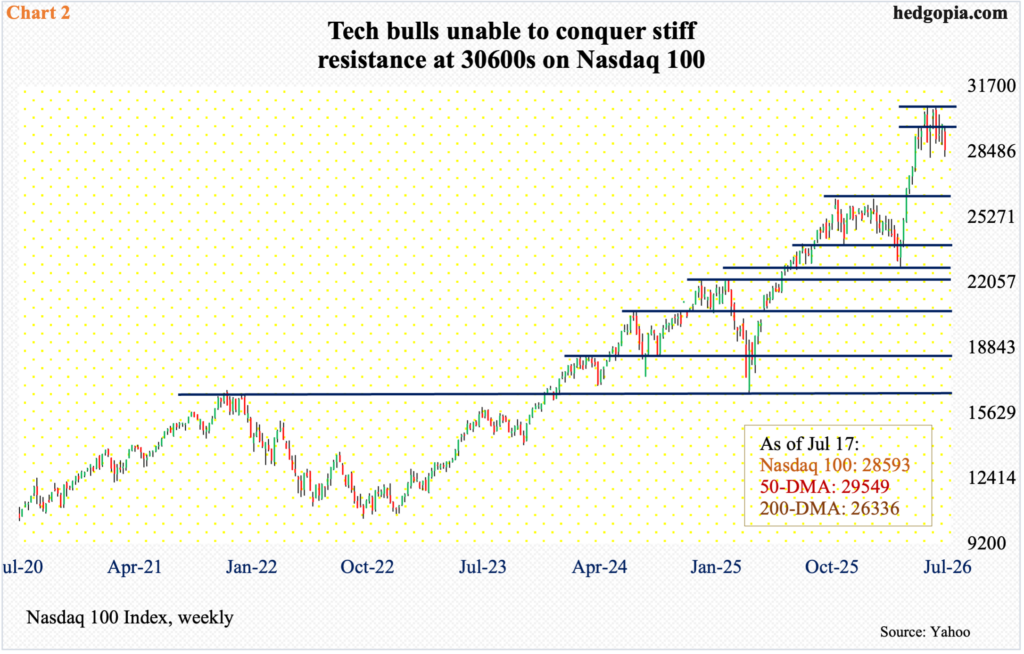
As shorts gradually began to build position, they have had a few opportunities to press their case, but those did not amount to much. This was particularly so from April last year when the major indices reached major lows. The Nasdaq 100, for instance, bottomed at 16542 back then, followed by another important low (22841) in March this year. Last week, the tech-heavy index closed at 28593, having registered a fresh high of 30762 on June 3.
From that high, the Nasdaq 100 has made a series of lower highs, even as 30600s were proving tough to crack (Chart 2). This technical picture is something the shorts probably drew a lot of encouragement from.
Last week, the index dropped 4.1 percent, with Friday’s intraday low 28231 within earshot of the June 9 low of 28197. The 50-day at 29549 has been decidedly breached. Tech is behaving this way ahead of June-quarter results from the heavyweights in the next couple of weeks. Google parent Alphabet (GOOG) and Tesla (TSLA) will report on the 22nd. Next week, Microsoft (MSFT) and Facebook parent Meta Platforms (META) are due out on the 29th, while Apple (AAPL) and Amazon (AMZN) will publish theirs on the 30th.
Right here and now, odds probably favor the shorts.
The negative price action last week came at a time when the major banks and brokers, such as JP Morgan (JPM) and Goldman Sachs (GS), reported better-than-expected numbers across the board, but only to be treated harshly in the markets.
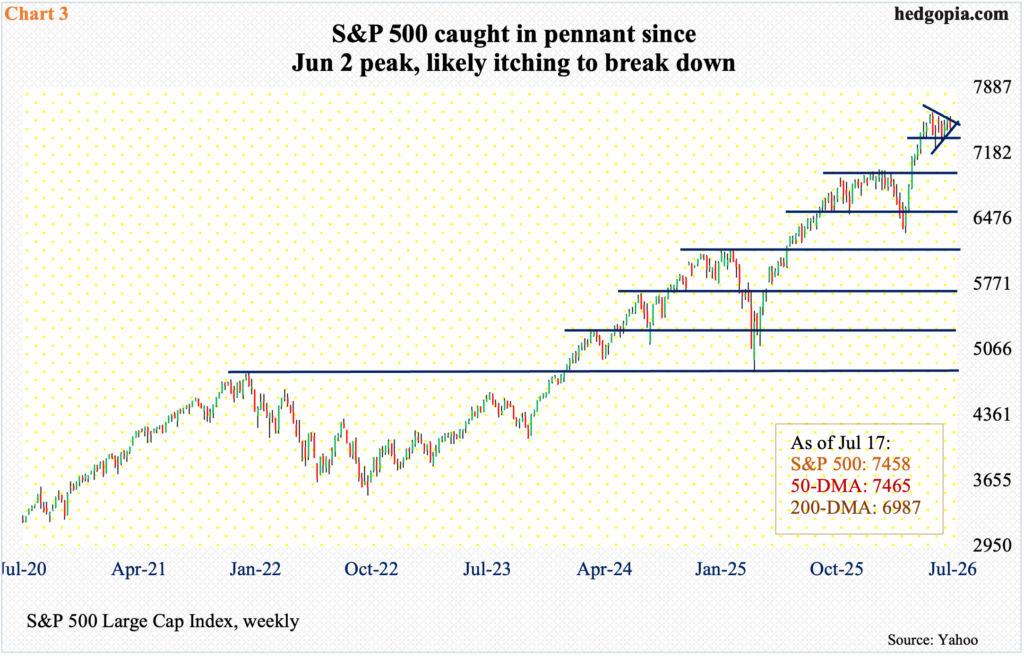
Accordingly, the S&P 500 last week gave back 1.6 percent to 7458. The large cap index has been under pressure in a sideways pattern since peaking at 7621 on June 2. It, in fact, has been caught within a pennant, with last Friday’s intraday low of 7431 just about testing the lower support (Chart 3). Risks are rising of a breach.
The 50-day at 7465 was slightly compromised last week. For six weeks now, the average has been tested four times. The index has struggled to jump right off the average. This is probably a sign that a decisive breach is just round the corner. When the time is ripe, a crucial breakout retest will take place at 7000, or just underneath.
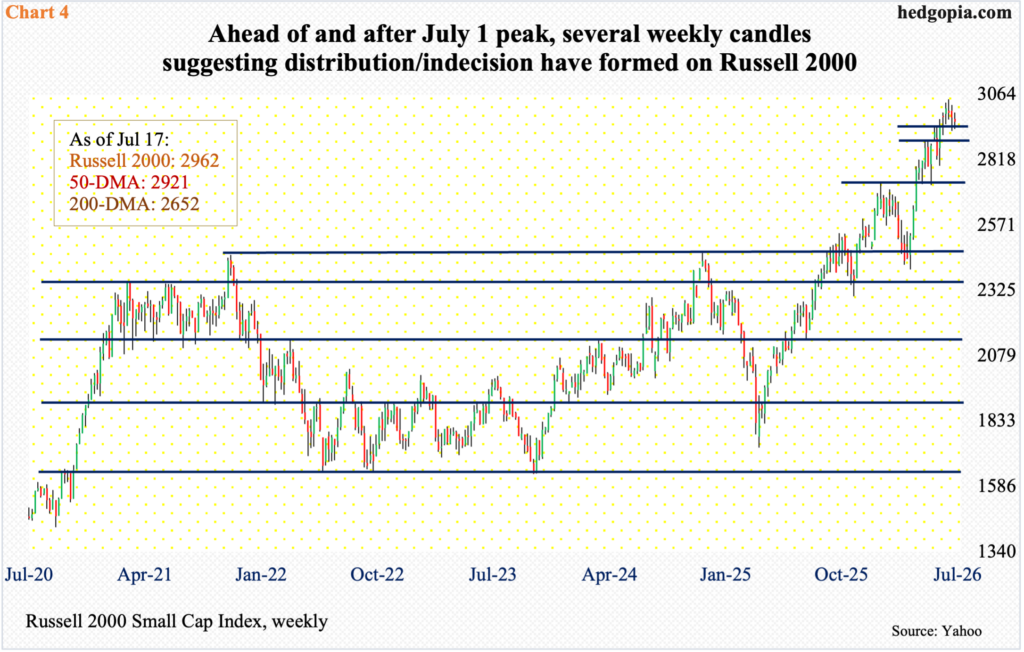
Over in the small-cap arena, the Russell 2000 dropped 0.5 percent last week to 2962, but the index remains above the nearest horizontal support at 2940s; last Friday, bids showed up at 2934, and at 2927 in the week before that.
The small cap index peaked at 3047 on the 1st this month. Leading up to and after that peak, several weekly candles smacking of distribution and/or indecision such as hanging man and spinning top have appeared (Chart 4).
This precedes a handsome rally from March 30, not to mention April last year. Once 2940s give way, the next layer of support lies at 2880s, followed by 2720s.
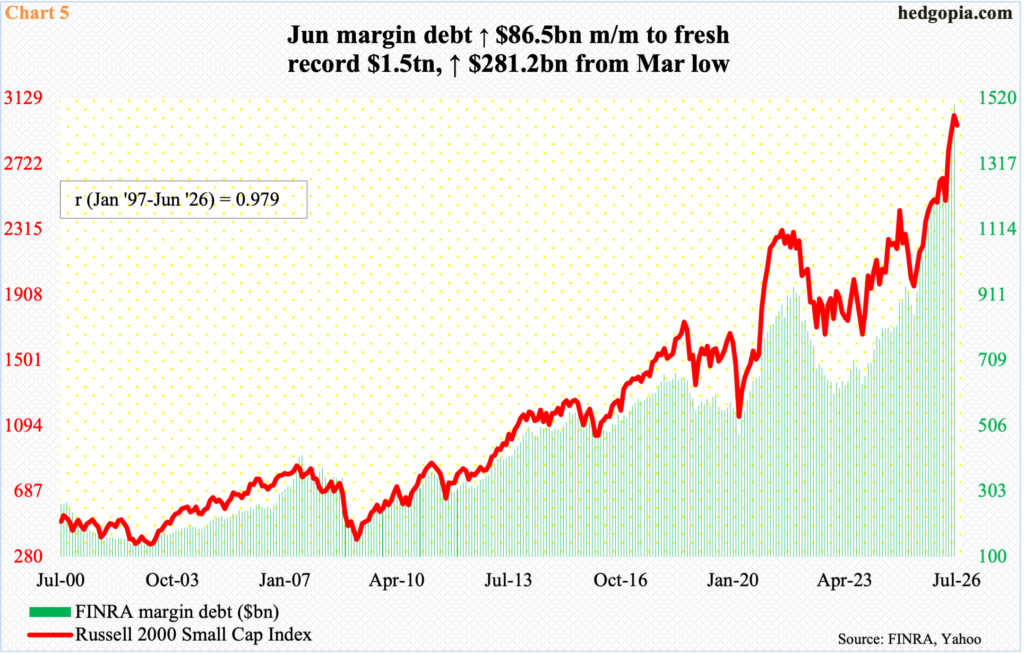
Incidentally, FINRA margin debt, which has a very tight correlation with the Russell 2000, reached a fresh high in June. At $1.5 trillion, June added $86.5 billion. From March alone, when equities bottomed, leverage has gone up $281.2 billion. There is a parabolic look to it in recent months (Chart 5).
The nature of margin debt is such that it cuts both ways. It is nice when equities are rallying, and leverage will help in such risk-on environment. The opposite is true when things reverse. As debtholders begin to reduce leverage, or even face a margin call, it can become a self-fulfilling prophecy. Selling begets selling. This will be a perfect environment for shorts, who are probably beginning to salivate looking at the way the indices are beginning to behave.
Thanks for reading!
