
With some FOMC members toying with the idea of a half-point increase in next month’s meeting, October’s PCE due out Wednesday is being watched keenly. This includes equity bulls who were humbled last week.
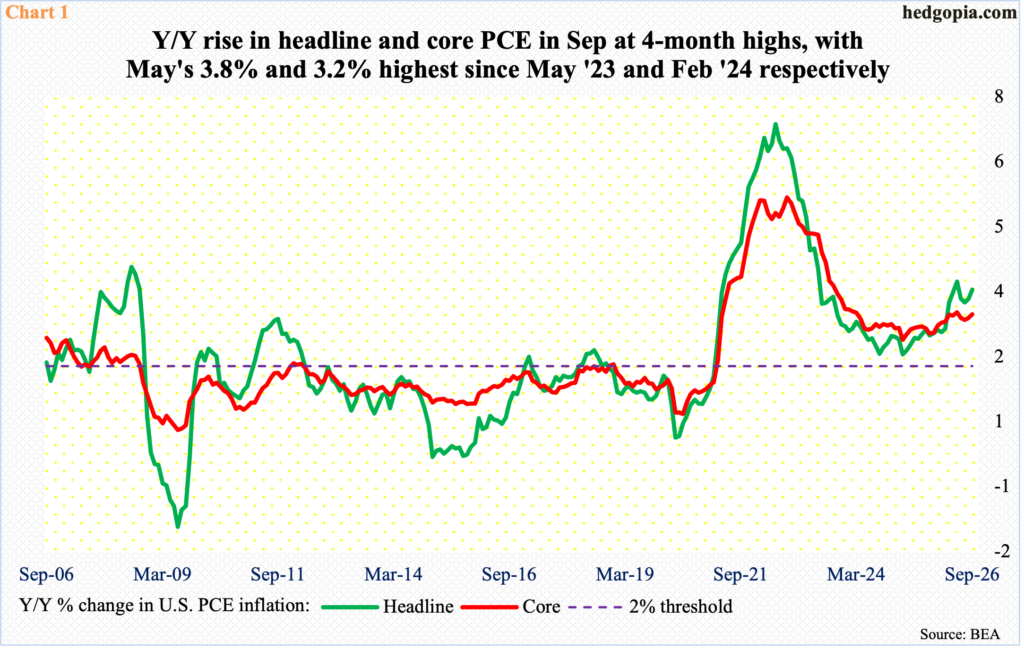
On Wednesday, October’s PCE (personal consumption expenditures) will be published, and this has the potential to sway FOMC (Federal Open Market Committee) votes.
Particularly after Kevin Warsh took over the Federal Reserve in May, inflation has once again been thrown into the spotlight. He has been doggedly maintaining that inflation remains elevated. The Fed targets two percent, but consumer inflation has exceeded that threshold for over five years now.
In October, CPI (consumer price index) came in stronger than expected, with both the headline and core rising 0.4 percent month over month, and the readings were 0.1 percentage point higher than the consensus. Hence the importance of Wednesday’s PCE, which is the Fed’s favorite.
In September, headline and core PCE grew 3.65 percent and 3.12 percent from a year ago, in that order. May’s 3.82 percent and 3.16 percent were the highest since May 2023 and February 2024 respectively (Chart 1). These are high readings and have been that way for a while.
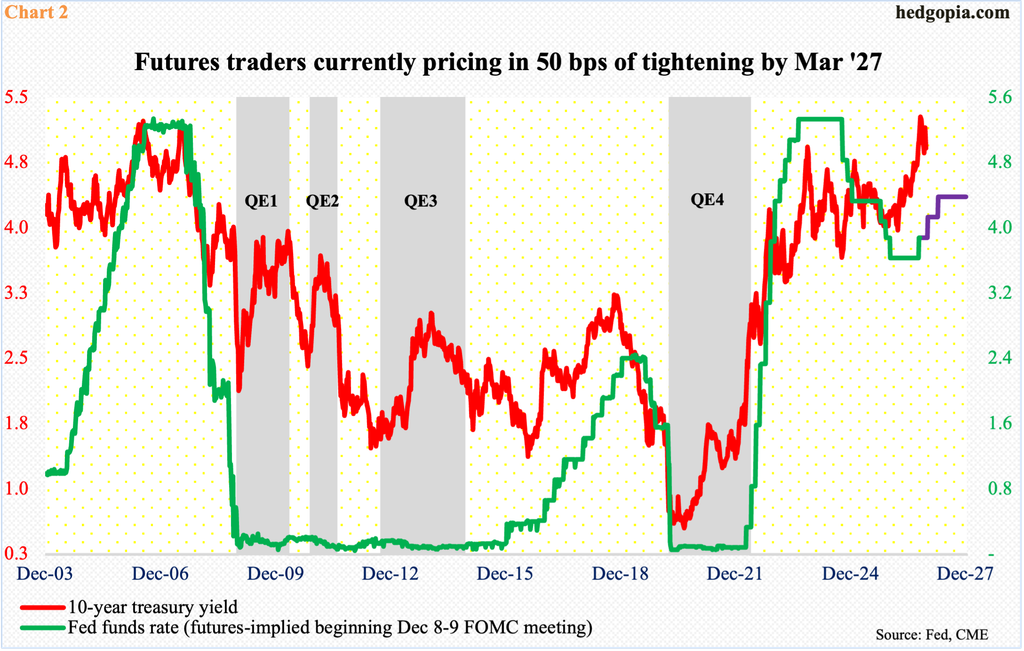
Depending on how PCE behaves in October, there is a possibility that traders will begin to give some thought to the chances of a 50-basis-point increase next month, slated for 8-9.
In the last meeting – October 27-28 – the fed funds rate was held steady at a range of 3.75 percent to four percent; in the prior meeting in September, for the first time since July 2023, the benchmark rate was raised by a quarter point (Chart 2).
As things stand, a 25-basis-point hike is priced in for next month, followed by another of similar increment by next March. But policymakers of late have also been mulling over a 50. Governor Christopher Waller in recent weeks has opined that they should consider 50 basis points next month.
Minutes for the October meeting were released last Wednesday, and it was revealed that two members suggested a 50-basis-point hike. Two others – Governor Lisa Cook and Cleveland Fed President Beth Hammack – dissented in favor of a 25-basis-point increase in a 10-2 vote and could ask for more should PCE not behave.
Alternatively, markets could begin to price in two quarter-point hikes, instead of one, next year. Or, the 10-year treasury yield, which dropped 24 basis points last week to 4.91 percent – just above horizontal support at 4.75s-4.81s – could reassert itself; the rate has been under pressure since ticking 5.36 percent on October 5.
A repricing in the interest-rate outlook – should one occur – would have come at a time when equities already are on the back foot, and it is tough to tell if this might discourage the bulls even more.
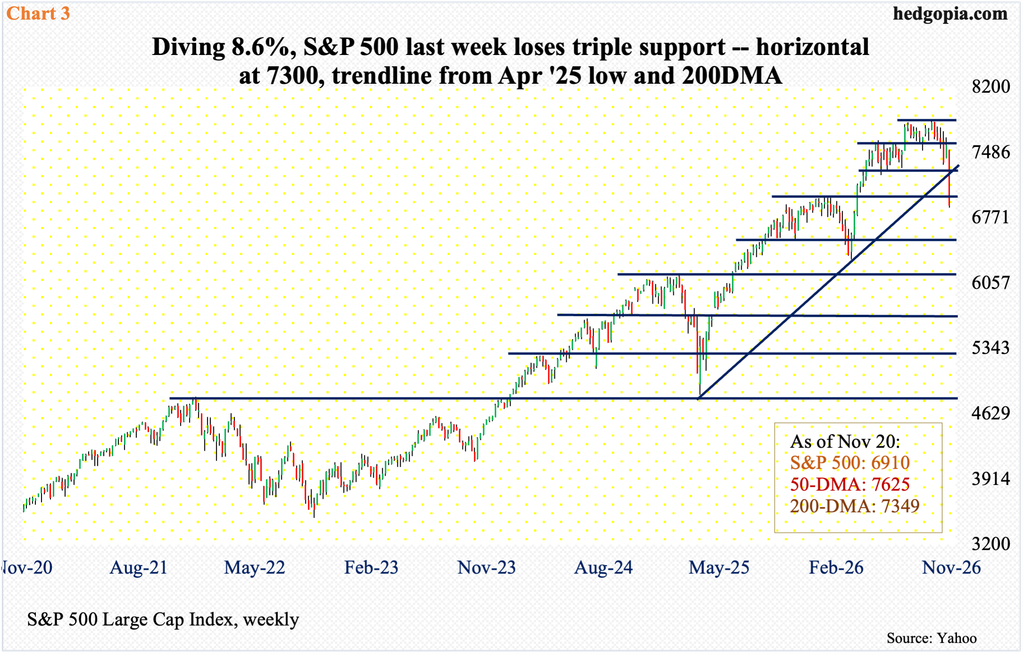
The S&P 500 peaked at 7845 on October 6 and was down 12.3 percent through last Friday’s session low 6833, before closing at 6910, down 8.6 percent for the week. Last week’s tumble cost the bulls not one, not two but three levels of support – the 200-day moving average at 7349, horizontal at 7300 and rising trendline from the April 2025 low (Chart 3). From that low through the October peak, the large cap index was up 62.2 percent, and 24.2 percent from this March’s low. These are massive gains.
The March 2026 bottom followed downward pressure after the index tried for four months through February but failed to take out 6900-7000. The hurdle was finally taken care of in April. With last week’s decline, the index has now completed a round trip to that level, and the bulls have an opportunity to regroup here. Inability to do so would raise the odds that the S&P 500 would just continue toward 6100-6300. In this scenario, indicators such as the percent of S&P 500 stocks above their 50- and 200-day (43.2 percent and 48.8 percent respectively) have the potential to reach extreme oversold levels, laying the foundation for a sound low.
Over on the Nasdaq 100, 32 percent and 36 percent of the constituent stocks are above the 50- and 200-day; this is low given 59.4 percent and 65.4 percent were above the averages late October and early this month respectively but do not yet represent washout levels.
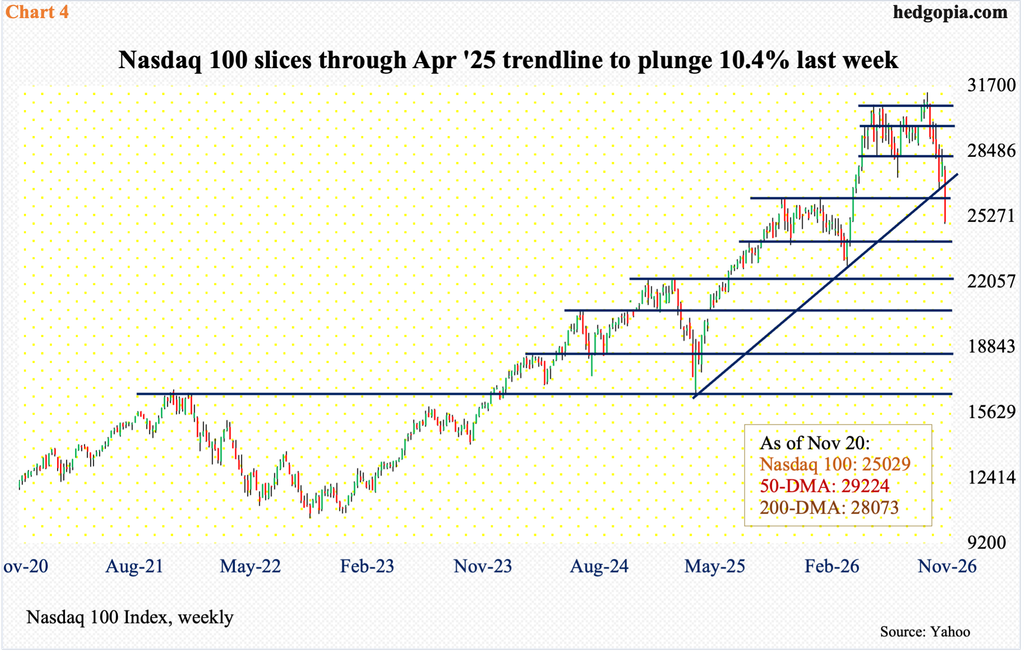
On the index itself, there was a sense of panic last Thursday and Friday, as the tech-heavy index collapsed 10.4 percent to 25029 for the week. On October 6, it peaked at 31361. From that high to Friday’s session low 24910, the Nasdaq 100 is down 20.6 percent, which is quite a drop in and of itself, but some perspective is in order here. From the lows of March this year and April last year, the Nasdaq 100 surged 37.3 percent and 89.6 percent respectively. Bulls, particularly those that got in early, are probably not panicking just yet.
That said, the index has been dealt some damage. The 200-day (28073) has been compromised. Ditto with trendline support from the April 2025 low, not to mention horizontal support at 26100s, which is where the bears are likely to show up should a reflex rally evolve in the sessions ahead.
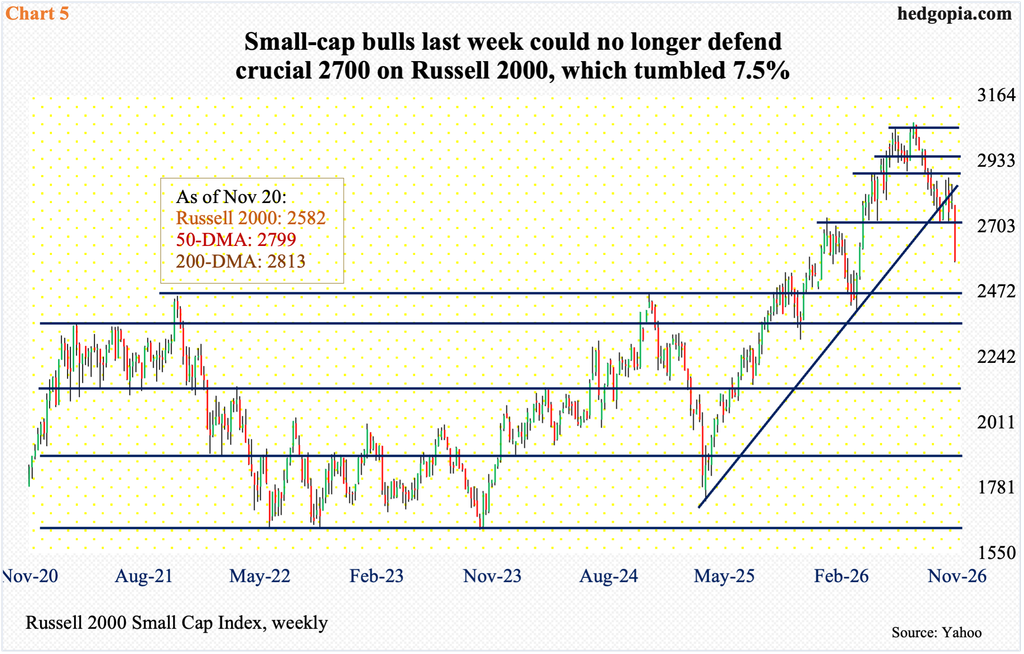
In small-caps, bulls last week were unable to stop the bears from claiming 2700. For the week, the Russell 2000 dove 7.5 percent to 2582, down 16.1 percent from the August 14 peak of 3070. After that peak, the index then kept bleeding for nine weeks before finding support just north of 2700, where it went sideways for five weeks, but only to breach the level last week. A rising trendline from the low of April last year has been violated as well (Chart 5).
Not surprisingly, the index is grossly oversold, particularly on the daily. A reflex rally is always possible, but should one develop, this likely will be used as an opportunity by the bears to reload and short at 2700.
Thanks for reading!
